Шановні відвідувачі! Сайт працює в тестовому режимі
- Головна
- Про інститут
- Відділи та наукові групи
- Ради, комітети, комісії
- Періодичні видання
Author:
Koliesnik Liudmyla Yaroslavivna, PhD in Philology, Researcher at the Department of Dialectology, Institute of the Ukrainian Language of the National Academy of Sciences of Ukraine, Kyiv, Ukraine
https://orcid.org/0000-0003-3321-2942
Responsible editor:
Hrytsenko Pavlo Yuhymovych, Doctor of Philology, Professor, Institute of the Ukrainian Language of the National Academy of Sciences of Ukraine, Kyiv, Ukraine
https://orcid.org/0000-0002-5363-6585
Scopus Author ID: 57198444655
Reviewers:
Rusnak Natalia Oleksandrivna, Doctor of Philology, Professor, Chernivtsi National University by Yuriy Fedkovych, Chernivtsi, Ukraine
https://orcid.org/0000-0001-5611-4494
Tkachuk Maryna Mykolaivna, PhD in Philology, Researcher at the Department of Dialectology, Institute of the Ukrainian Language of the National Academy of Sciences of Ukraine, Kyiv, Ukraine
https://orcid.org/0000-0002-4165-7741
Affiliation: Institute of the Ukrainian Language of the National Academy of Sciences of Ukraine
Year: 2018
Pages: 640
ISBN 978-111-489-680-8
Language: Ukrainian
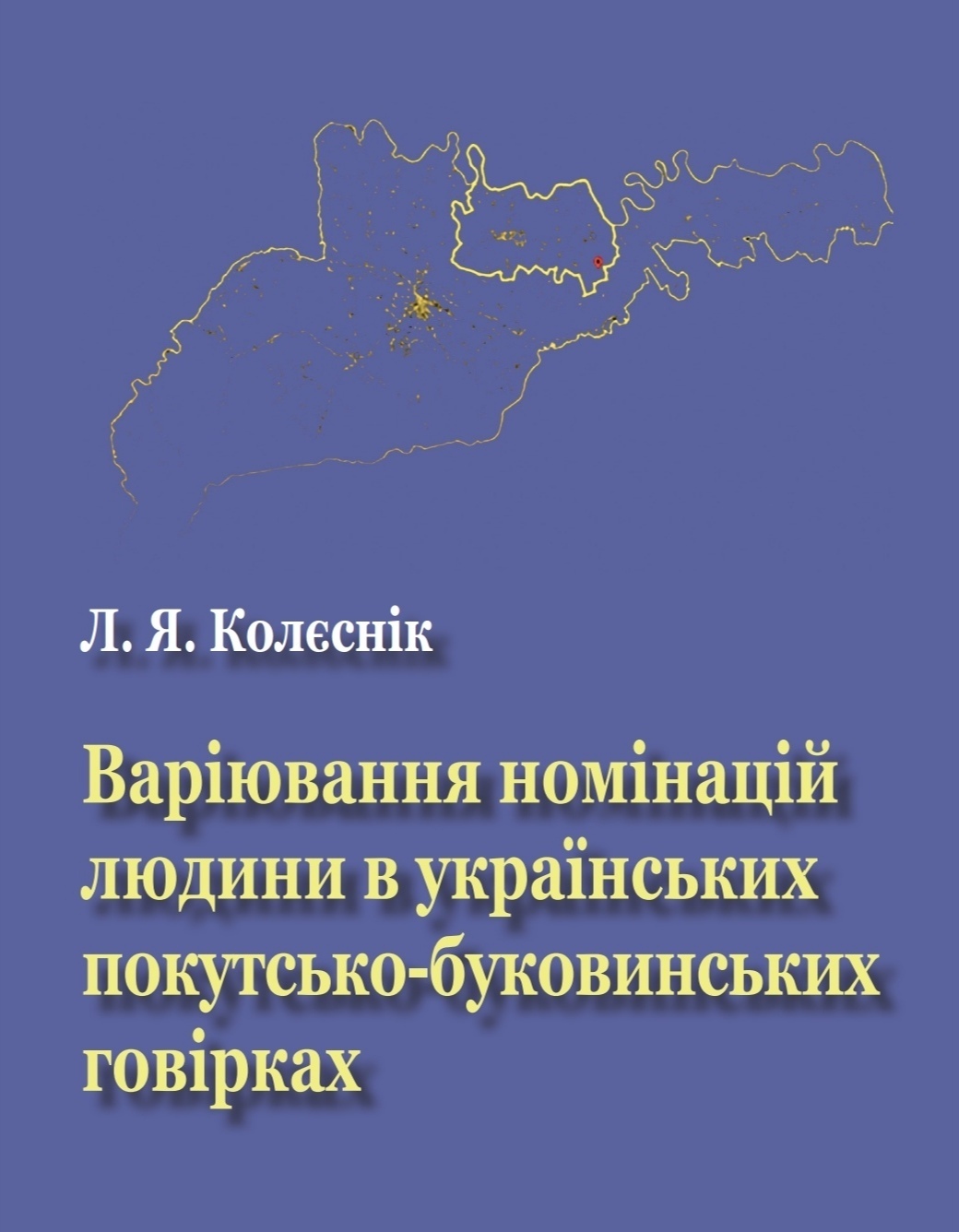
The monograph is devoted to the problem of variation of dialect vocabulary in the outlined locus of the Ukrainian language — the old Pokuttia-Bukovyna dialects.
The research is based on a significant dialect material of more than 4,500 lexical units (without phonetic variants). The material was collected in dialectological expeditions in the dialects of Northern Bukovyna, Pokuttya and Bukovynian Hutsulshchyna during 2008—2017 on a special questionnaire. Part of the identified names is not fixed in lexicographic sources and introduced into scientific circulation for the first time. Dialectal texts-narratives provide additional information for understanding the semantics, motivation and origin of these tokens, as well as revealing the functional side of the studied vocabulary.
The dialect vocabulary of the Pokuttia-Bukovyna dialects is analyzed from the point of view of its lexical-semantic affiliation to thematic groups of vocabulary, structure, origin, semantics and motivation. Within the description of the linguistic representation of individual values, emphasis is placed on the formal variation of vocabulary, which is conditioned by the internal processes of the development of dialectal language: the tendency towards linguistic economy, formal changes of words in spontaneous speech. Formal changes in turn can provoke a change in the semantics of a word or its connotations.
Common root word derivatives are analyzed. The research material confirms the conclusions of scientists that the amount of word-building means for the derivation of derivatives depends on the level of evaluation of the phenomenon described, in particular its high level provokes a larger repertoire of suffixes for the derivation of derivative words in dialects.
One of the factors of formal and semantic variation in the outlying area is the proliferation of a significant amount of borrowed vocabulary. In particular, on the example of one group of vocabulary (agnostic names), borrowing amounts to ≈ 22% of the total. Of all borrowings of germanisms — 31.8%, Romanians — 20%, polonisms — 19.3%. The remaining 29% is borrowed from Western European languages, ancient Latin and Russians. This is due to the historical development of Bukovyna and Pokuttia, which for a considerable time belonged to foreign states, the existence of a foreign (for a long time non-Slavonic) language as official.
In the investigated locus there is a phenomenon of interference due to the interlingual interaction of dialectal oral systems — Ukrainian and East-Roman. Interlingual interference is also manifested in the use of typical motivational models that are specific to one of the languages. Such tendencies are supported by the compact residence of the local population in a foreign environment, international marriages.
One of the manifestations of semantic variation of vocabulary is the distribution of a significant number of secondary nomens, which are used for the most accurate characteristics of objects, expression of the relation to the phenomenon described, enhanced expression. The use of the studied vocabulary, in particular the secondary nomination, reveals specific perceptions of the environment, ways of managing, moral and ethical guides of the speakers, the attitude to social changes and social institutions — all that forms the linguistic picture of the world of modern dialectal carriers.
The study of vocabulary in the area projection allowed us to draw conclusions about the trends of its distribution within the defined range. Atlas maps show that the spatial behavior of the studied vocabulary is most commonly characterized by an arbal mosaic, illustrate the localization of borrowing both within the frontal contacts area and throughout the study area. The proliferation of the names of the literary language on the designation of certain concepts throughout the studied territory testifies to the monolithic nature of the Pokuttia-Bukovyna dialects.
The second part of the book is a thematic dictionary and lexical regional atlas.
The book will be useful for scholars-dialectologists, historians of Ukrainian and other Slavic languages, lexicographers, teachers of higher educational institutions, students, and everyone interested in Ukrainian folk speech.
Recommended for publication by the Academic Council of the Institute of the Ukrainian Language of the NAS of Ukraine (Minutes No. 12 of December 5, 2018).
Keywords: Pokuttia-Bukovyna dialects, dialect variation, language interference, secondary nomen, linguistic mapping.